
What Causes Garage Door Springs to Break in the First Place?
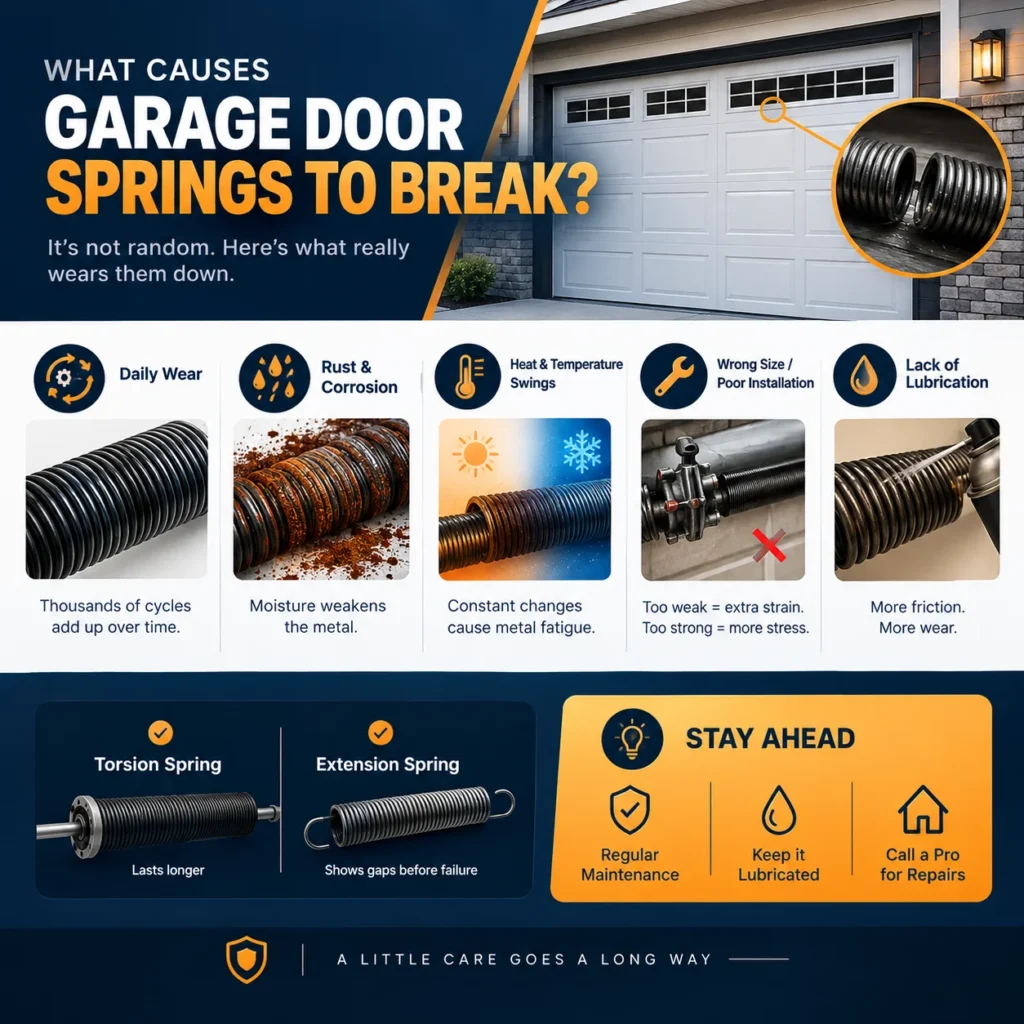
A garage door spring doesn’t fail randomly. By the time you hear that loud bang from the garage, weeks or even months of quiet damage have already happened: heat, moisture, and thousands of lift cycles wearing the steel down until it finally gives out.
Quick Answer: Garage door springs break due to a combination of factors: normal wear from repeated open-close cycles, rust and corrosion from humidity, metal fatigue caused by heat and temperature swings, incorrect spring sizing, and lack of routine lubrication. Most springs are rated for 10,000–15,000 cycles, but climate and maintenance habits can shorten that lifespan significantly, sometimes by several years.
Torsion vs. Extension Springs — Why It Matters
Before getting into why springs fail, it helps to know which type is holding your door up, because the failure pattern isn’t identical for both.
Torsion springs sit horizontally above the door, mounted on a metal shaft. They store energy by twisting, and they’re the more common choice in newer homes because they last longer and are safer under tension. Extension springs run along the horizontal tracks on either side of the door and stretch to store energy instead of twisting.
Torsion springs typically last longer often rated for 15,000–20,000 cycles versus 10,000 for standard extension springs but both types fail for largely the same underlying reasons: fatigue, corrosion, and cycle count. The difference is mostly in how the failure shows up. A torsion spring failure is usually a sudden, complete snap. Extension springs sometimes show visible gaps between coils before they fully give out, which is actually a useful early warning sign if you know to look for it.
The Core Reasons Garage Door Springs Break
1. Normal Wear and Cycle Count
Every garage door spring has a rated lifespan measured in cycles one cycle equals one full open-and-close movement. A standard residential spring is built for roughly 10,000 cycles. If your household opens the garage door four times a day, that’s about 1,460 cycles a year, putting the spring on track to wear out in 6-7 years even under ideal conditions. Homes with more frequent use multiple drivers, a garage used as a main entry point burn through that cycle count faster.
2. Rust and Corrosion
Moisture is one of the fastest ways to age a spring before its time. Humidity in the air settles onto the coils, and without a protective coating or regular lubrication, rust begins forming on the surface of the metal. Rust doesn’t just look bad it actually weakens the coil from the inside by creating tiny pits in the steel. Those pits act as stress points, and under tension, that’s exactly where a spring is most likely to snap.
3. Metal Fatigue From Heat and Temperature Swings
Steel expands when it heats up and contracts as it cools. Every time that happens, the metal experiences a small amount of stress. Do that thousands of times over several years, especially with sharp swings between hot afternoons and cool nights, and the metal fatigues faster than it would in a stable, moderate climate. This is a big part of why the same spring, rated the same way, can last noticeably longer in a mild climate than in one with big daily temperature shifts.
4. Incorrect Spring Size or Poor-Quality Installation
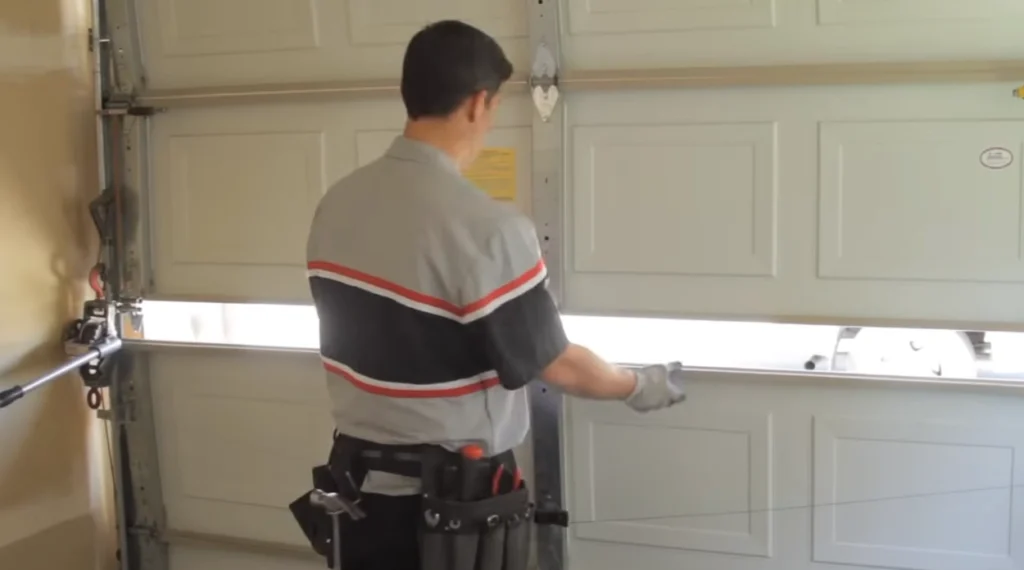
Springs are sized based on the weight, height, and material of your specific garage door there’s no universal “one size fits all” spring. If a spring was installed that’s too weak for the door’s actual weight, it will be under constant excess strain and fail well ahead of schedule. This is a surprisingly common issue with poorly done previous repairs, where a technician grabs whatever spring is on the truck instead of calculating the correct size for the door.
5. Lack of Lubrication and Maintenance
Springs need periodic lubrication with a silicone-based or garage-door-specific lubricant to reduce friction between coils as they expand and contract. Without it, coils rub against each other during every cycle, accelerating wear and creating small surface abrasions where rust can take hold more easily. This is one of the few causes on this list that’s almost entirely preventable with a five-minute maintenance task a couple of times a year.
6. Age of the Door and System
Even with perfect maintenance, springs don’t last forever. Manufacturers typically estimate a working lifespan of 7-10 years under average conditions. If your garage door system hasn’t had any spring work done in over 7 years, age alone puts you in the higher-risk window, regardless of how well the spring has been maintained.
Why Climate Plays a Bigger Role Than Most Homeowners Realize
National guides tend to quote that standard 7-10 year spring lifespan as if it applies everywhere equally but climate meaningfully changes the math. In hot, humid regions, three things compound at once:
- Heat accelerates the expansion-contraction cycle that fatigues steel
- Humidity speeds up rust formation on unprotected coils
- Temperature swings between hot days and cooler nights add extra mechanical stress on top of normal wear
Put together, homeowners in hot, humid climates often see torsion springs fail closer to the 6-8 year mark rather than the 7-10 years quoted in generic national guides even with a completely average household cycle count. This is why a spring that seems to be “failing early” often isn’t a manufacturing defect at all; it’s the climate doing exactly what climate does to unprotected steel over time.
Warning Signs Your Spring Is About to Fail
A spring rarely breaks with zero warning. These are the signals worth paying attention to before it happens at the worst possible moment:
- Visible gaps between coils (most noticeable on extension springs)
- Rust spots or flaking on the spring itself
- The door feels heavier than usual when opened manually
- A loud popping or grinding noise during operation
- The door opens unevenly or looks slightly crooked as it moves
- It’s been more than a year since the springs were last inspected or lubricated
If you notice any of these, it’s worth getting the spring inspected before it fails completely a controlled replacement is far cheaper and safer than an emergency one.
What to Do the Moment a Spring Breaks
If you hear the telltale loud bang and the door won’t move, here’s what matters most:
- Don’t try to force the door open manually. A broken spring means the counterbalance system is gone, and the door is now far heavier than it looks.
- Don’t attempt a DIY spring replacement. Garage door springs are under extreme tension and are a well-documented cause of serious injuries, including eye and hand injuries, when handled without the right tools and training.
- Use the emergency release cord only if the car is trapped inside and you understand that lifting the door manually afterward will be significantly harder without spring support.
- Call a licensed technician for a same-day inspection and replacement rather than attempting a workaround.
How to Extend Your Garage Door Spring’s Lifespan
While every spring eventually reaches the end of its cycle life, a few habits genuinely push that timeline further out:
- Lubricate the springs twice a year with a silicone-based garage door lubricant
- Schedule an annual inspection, ideally before the season with the most temperature swings in your area
- Avoid excessive daily cycles where possible; using a secondary entrance instead of the garage door for quick trips reduces wear
- Address rust immediately if spotted, rather than waiting for the next scheduled service
- Confirm the correct spring size was used any time replacement work is done, rather than assuming a prior installation was correct
Real Questions, Straight Answers
Final Thoughts
A broken garage door spring almost always comes down to some combination of cycle count, corrosion, heat-driven metal fatigue, or a spring that was never sized correctly for the door in the first place, and climate quietly speeds up nearly all of those factors at once. Regular lubrication and an annual inspection won’t make a spring last forever, but they will buy you real time and, more importantly, a warning before it fails rather than a loud bang on a Tuesday morning.
Notice any of the warning signs above? Call (346) 514-5120 for a same-day inspection and a written estimate before any work begins.